Discover how digital twin technology is transforming the automotive industry from design to service, with market growth reaching $34.6B by 2032.

Drivetech Partners
The automotive industry is experiencing a transformative shift powered by digital twin technology, with market projections showing growth from $2.2 billion in 2022 to an astonishing $34.6 billion by 2032. These virtual replicas are revolutionizing every aspect of the automotive value chain—from design and manufacturing to maintenance and customer engagement—enabling automakers to innovate faster, reduce costs, and create more sustainable vehicles.
Key Takeaways
- The automotive digital twin market is growing at an impressive 32.6% CAGR, reaching $34.6 billion by 2032
- Digital twins create detailed virtual replicas that enable virtual prototyping and testing, significantly reducing development costs
- Major manufacturers like BMW partner with tech companies to create virtual factory environments that optimize production
- Digital twins can reduce supply chain costs by up to 15% in distribution centers
- The technology enables new revenue streams through predictive maintenance services and personalized customer experiences
Digital Twin Technology Fundamentals: The Virtual Backbone of Modern Automotive
At their core, automotive digital twins are comprehensive virtual replicas of physical vehicles, components, or manufacturing processes. These dynamic models leverage a powerful combination of technologies including artificial intelligence, Internet of Things (IoT) sensors, machine learning algorithms, and cloud computing platforms to create functioning digital counterparts that mirror their physical twins throughout their lifecycle.
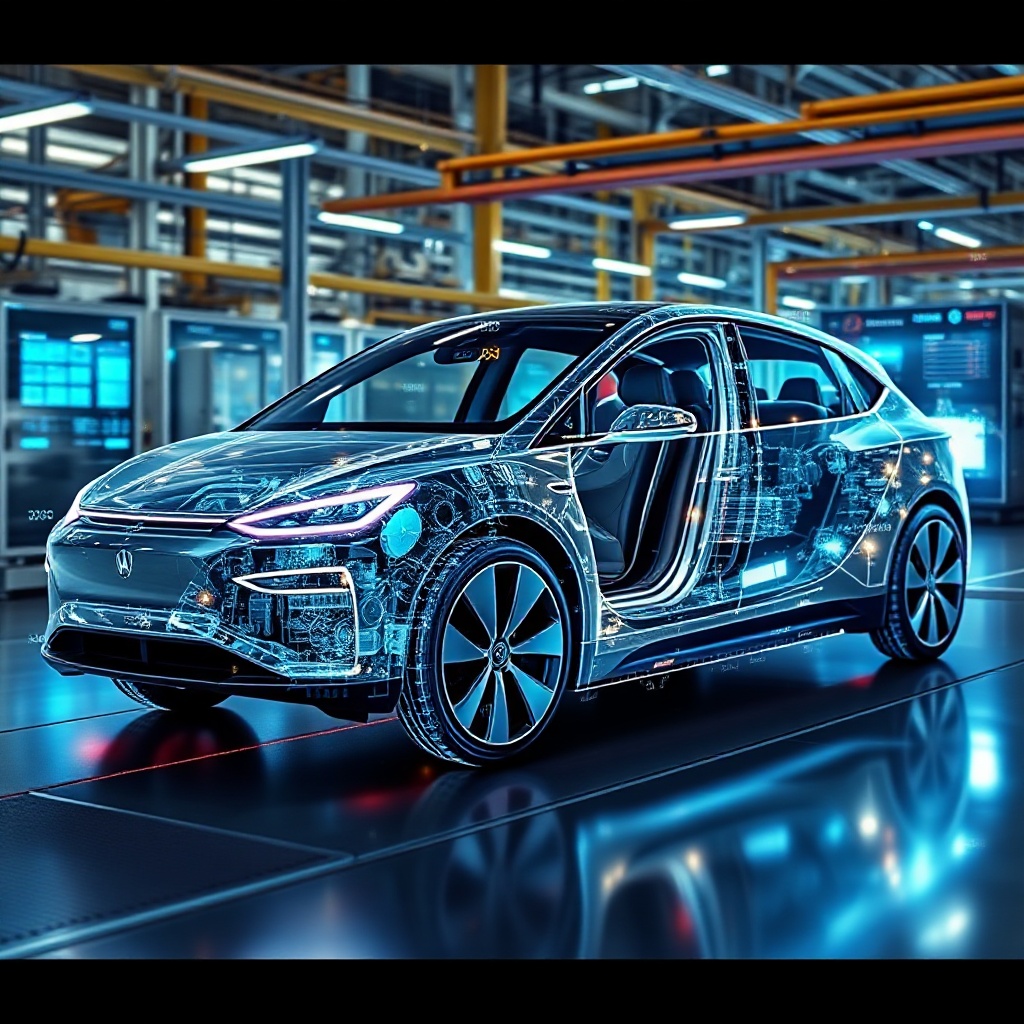
The automotive industry employs three main categories of digital twins:
- Product Digital Twins: Virtual models of vehicles or specific components that simulate performance, materials, and functionality
- Process Digital Twins: Simulations of manufacturing operations that optimize assembly lines and production workflows
- System Digital Twins: Integrated ecosystem views that connect product and process twins to create holistic operational insights
This three-tiered approach allows automotive companies to create interconnected virtual environments that can simulate nearly any aspect of a vehicle's design, production, or operation with remarkable accuracy.
Virtual Design and Testing: Revolutionizing Vehicle Development
One of the most significant applications of digital twin technology is in virtual vehicle prototyping. Traditional automotive development requires multiple physical prototypes, each costing millions of dollars and taking months to produce. Digital twins dramatically reduce this dependency by allowing engineers to test and refine designs in virtual environments.
Volkswagen, for example, uses digital twins to optimize electric vehicle battery designs, testing hundreds of virtual iterations before committing to physical prototypes. These simulations can analyze complex aerodynamic performance under various conditions, predict battery degradation over time, and evaluate materials durability—all without building a single physical model.
The technology also enables virtual crash testing and safety validation, subjecting digital vehicles to extreme conditions that would be difficult, dangerous, or prohibitively expensive to replicate physically. This capability accelerates innovation cycles and allows for rapid design improvements that would be impossible with traditional testing methods.
Smart Manufacturing: The Factory of the Future
Digital twins are transforming automotive manufacturing through the creation of complete virtual factory replicas. BMW's partnership with NVIDIA Omniverse exemplifies this approach, creating detailed digital models of entire production facilities to optimize workflows, test new manufacturing processes, and identify potential bottlenecks before they impact physical operations.
These virtual factories enable advanced monitoring of complex manufacturing processes, including precision welding, composite material formation, and robotic assembly. Deep learning algorithms analyze the data from these digital twins to improve quality control and production accuracy, while facilitating real-time production adjustments based on performance data.
The benefits extend beyond production efficiency. Digital twins help manufacturing teams:
- Simulate equipment maintenance schedules to minimize downtime
- Optimize energy usage across production lines
- Test factory floor layouts to improve worker safety and productivity
- Validate new automation systems before physical implementation
Supply Chain Optimization and Resilience
The automotive industry's complex global supply networks are gaining significant benefits from digital twin technology. Virtual replicas of entire supply chains provide end-to-end visibility and enable predictive analytics that can identify potential disruptions before they occur.
The financial impact is substantial. Digital supply network twins can reduce distribution center costs by up to 15% through optimized logistics and inventory management. Suppliers using this technology save an average of $500,000 yearly by reducing rework through improved predictive capabilities.
Integration with existing supply chain management systems—including Advanced Planning Systems (APS), Warehouse Management Systems (WMS), and Transportation Management Systems (TMS)—creates a comprehensive digital ecosystem that enhances risk management and enables rapid response to market changes, parts shortages, or transportation disruptions.
Predictive Maintenance and Connected Mobility Services
For vehicles already on the road, digital twins enable sophisticated preventive maintenance capabilities through real-time monitoring of vehicle health and component conditions. IoT sensors continuously feed operational data to digital twins, which analyze performance patterns to predict maintenance needs before failures occur.
This predictive approach is particularly critical for autonomous vehicles, where system reliability is paramount. Digital twins also support continuous performance optimization through over-the-air updates and real-time analytics, allowing manufacturers to improve vehicle functionality throughout its lifecycle.
Electric vehicles especially benefit from digital twin technology in their battery management systems. The technology helps optimize charging cycles, predict range based on driving conditions, and extend battery life through data-driven insights—addressing key concerns for EV adoption.
Autonomous Driving and EV Performance Advancement
Digital twins provide essential support for the development of autonomous driving technologies by creating safe, repeatable testing environments for self-driving algorithms. These virtual environments can simulate countless driving scenarios without the risks, costs, or time constraints of physical road testing.
For electric vehicles, digital twins optimize battery management systems and improve range prediction accuracy by simulating how different driving styles, weather conditions, and routes affect energy consumption. The technology also supports system updates and performance improvements in connected vehicles, allowing manufacturers to enhance functionality through software rather than hardware changes.
Key applications in this area include:
- Testing autonomous driving systems across thousands of virtual driving scenarios
- Optimizing electric powertrain efficiency under various conditions
- Developing more accurate range prediction algorithms for EVs
- Creating personalized driving profiles that optimize performance and efficiency
Future-Proofing: Sustainability, Compliance, and Customer Engagement

Beyond operational improvements, digital twins support automotive companies in meeting evolving regulatory requirements and sustainability goals. The technology facilitates regulatory traceability through features like EV battery passports and component tracking, ensuring compliance with increasingly stringent environmental regulations.
Digital twins also enable simulation of environmental, social, and governance (ESG) impacts, including CO2 footprint and energy usage across the vehicle lifecycle. This capability helps automakers develop more sustainable products and manufacturing processes in response to growing environmental concerns.
On the customer side, digital twins enable interactive buying experiences through 3D configurators and virtual reality showrooms. These tools allow customers to explore vehicle options and features in immersive digital environments before making purchase decisions.
Leading companies including BMW, Volkswagen, Siemens, IBM, and SAP are at the forefront of this technology, creating new revenue streams through personalized services and after-sales monitoring that enhance customer relationships throughout the vehicle ownership experience.
As the automotive industry continues its digital transformation, digital twins will play an increasingly central role in connecting vehicles, manufacturers, suppliers, and customers in a more intelligent, efficient, and sustainable mobility ecosystem.
Sources
EIN Presswire: Digital Twins in Automotive Market to Surge from $2.2 Billion in 2022 to $34.6 Billion by 2032 at 32.6% CAGR
SCILTP: Review of Digital Twin in the Automotive Industry
Cintoo: Revolutionizing Supply Chain Management with Digital Twins
GMI Research: Global Digital Twin Market
ATT: Digital Twin Technology in the Automotive Industry