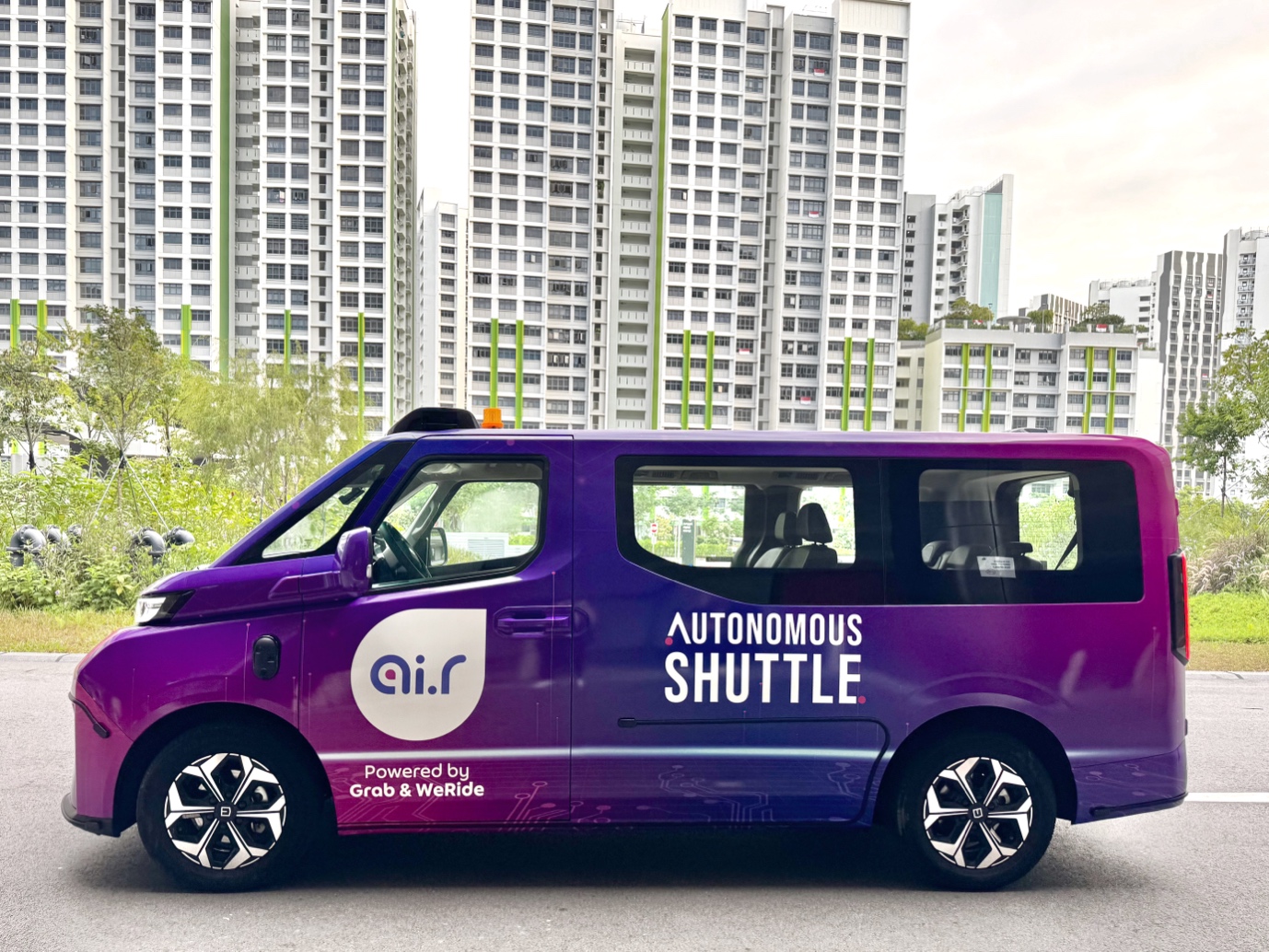
Singapore launches Ai.R robotaxi service in Punggol with WeRide and Grab, completing 30,000km of testing. Free rides connect residents to key locations.

Drivetech Partners
Singapore has launched the Ai.R robotaxi service through a partnership between WeRide and Grab, deploying autonomous GXR and Robobus vehicles in Punggol that have already completed 30,000km of testing and transported over 1,000 early riders. This deployment represents a critical milestone in the city-state's plan to integrate driverless technology into everyday urban transport, with free public rides now connecting residents to essential amenities while former Grab drivers transition into AI monitoring roles.
Key Takeaways
- The Ai.R robotaxi service has safely completed 30,000km of trials (equivalent to 750 Singapore-to-Kuala Lumpur trips) and served over 1,000 riders in Punggol.
- Singapore aims to deploy 100-150 autonomous vehicles island-wide by 2026, including driverless buses on routes in Marina Bay and one-north.
- An $8.1 million contract will bring six electric 16-seater driverless buses from a consortium of MKX Technologies, Zhidao Network Technology, and BYD starting mid-2026.
- Former Grab drivers are being upskilled into safety operators who monitor autonomous systems, addressing workforce transitions in the transport sector.
- The vehicles use Level 4 automation technology with LiDAR sensors, cameras, radar, and V2X communication for full autonomous operation in defined areas.
WeRide and Grab Launch Ai.R Robotaxi Service
The Ai.R robotaxi service represents Singapore's most ambitious driverless mobility initiative to date. WeRide and Grab have deployed their GXR and Robobus vehicles specifically in Punggol, a residential district that's become a testing ground for autonomous technology. These vehicles have accumulated an impressive safety record through extensive pre-launch trials.
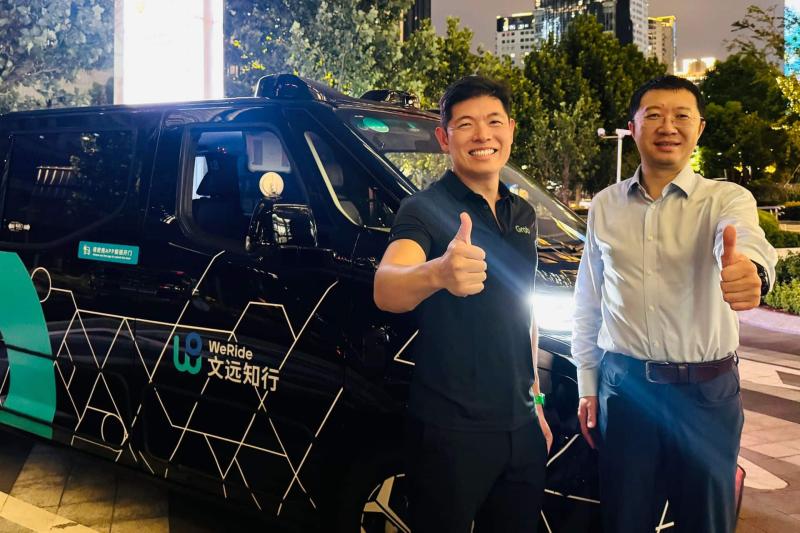
Grab’s Chief Executive Officer and Co-Founder, Anthony Tan, and WeRide’s Founder and Chief Executive Officer, Dr. Tony Han, with WeRide’s GXR in Shanghai, China
The 30,000km of safe operation logged by these vehicles equals approximately 750 round trips between Singapore and Kuala Lumpur. More than 1,000 early riders have experienced the service during rigorous testing phases. This extensive trial period wasn't just about logging miles—it integrated community feedback at every stage to build public trust and refine the user experience.
Community input shaped everything from pick-up point locations to in-vehicle comfort features. Residents provided feedback on navigation through narrow Punggol roads, response times during peak hours, and accessibility features for elderly passengers. This iterative approach has proven essential for creating a service that truly meets local needs rather than imposing a one-size-fits-all solution.
Free Public Rides and Workforce Transition
Punggol residents can now access free public rides connecting them to essential destinations throughout the district. The service links passengers to MRT stations, shopping complexes, and community centers—addressing the critical last-mile connectivity challenge that traditional public transport often struggles with. These complimentary rides will continue through Q2 2026 as part of the extended public access trial phase.
The workforce transition component deserves particular attention. Former Grab drivers haven't been left behind—they're being retrained as safety operators and AI monitors. This shift from hands-on driving to supervisory roles represents a significant evolution in transport employment. Instead of operating the vehicle directly, these professionals now monitor multiple autonomous systems, ready to intervene if needed and providing an extra layer of passenger reassurance.
Traditional driver positions required constant attention to a single vehicle. AI monitoring roles involve overseeing multiple vehicles simultaneously, analyzing system alerts, and managing passenger support requests remotely. Training programs equip former drivers with skills in autonomous system diagnostics, remote vehicle management, and emergency protocol execution. This upskilling strategy addresses automation concerns by creating new career pathways rather than simply eliminating jobs.
The pathway to commercial operations is clearly defined. As rider numbers grow and the technology proves itself through millions of additional kilometers, paid services will gradually replace free trials. Projected rider growth curves suggest commercial viability within the next 18-24 months, contingent on sustained safety performance and regulatory approval.
Singapore's Ambitious 2026 Autonomous Vehicle Targets
Singapore's Land Transport Authority has set a clear target: 100-150 autonomous vehicles operating island-wide by the end of 2026. This isn't a distant vision—it's a concrete goal backed by substantial government investment and regulatory framework development. The deployment will extend far beyond Punggol's initial trials to encompass multiple districts and use cases.
Driverless buses will operate on two specific routes according to The Straits Times. Route 400 will serve the Marina Bay and Shenton Way business districts, with stops at Marina Bay Cruise Centre, Gardens by the Bay, and Downtown MRT. Route 191 will connect the one-north tech hub with Buona Vista MRT, serving Singapore's innovation corridor where tech companies and research institutions cluster.
The five-year expansion plan scales operations systematically. Current Punggol shuttle trials demonstrate technical feasibility in residential settings. Marina Bay routes will prove capability in high-density business districts with complex traffic patterns. One-north deployment targets Singapore's tech-savvy population most likely to embrace autonomous transport. This phased approach allows for continuous learning and adaptation before full island-wide rollout.
Scalability from 6-20 buses shows built-in flexibility. Initial deployments will establish operational protocols and maintenance systems. If demand exceeds capacity or additional routes prove viable, the fleet can expand without requiring entirely new contracts or partnerships. This adaptive deployment strategy reduces risk while maintaining growth potential.
$8.1 Million Driverless Bus Contract and Deployment Details
The Land Transport Authority awarded an $8.1 million contract for six 16-seater electric driverless buses, with provisions to expand to 20 vehicles based on demand and performance. This represents Singapore's first major public investment in autonomous bus technology for regular route service rather than limited trials.
A three-company consortium will deliver the system. MKX Technologies handles research, development, and overall project management, coordinating between technical partners and government requirements. Zhidao Network Technology (Beijing) provides the autonomous vehicle software and hardware suite, including all sensors and decision-making algorithms. BYD manufactures the electric buses themselves, leveraging their experience producing similar vehicles for Chinese and Japanese markets.
Operations begin mid-2026 with a carefully structured safety transition. Initial deployments include onboard safety operators who can take control if needed. As the system proves reliable, these operators will shift to remote monitoring centers where they'll oversee multiple vehicles simultaneously. This gradual transition mirrors successful autonomous deployments in other cities while maintaining Singapore's strict safety standards.
The three-year pilot phase operates under standard public transport fares, making these buses financially accessible to all residents rather than premium services for early adopters. Passengers will pay the same as conventional buses, removing economic barriers to adoption. Driver training occurs through the Singapore Bus Academy, which has developed specialized curricula for autonomous vehicle monitoring and emergency response.
This deployment marks the first integration of this particular technology stack outside China. While Zhidao's systems have operated in Beijing and other Chinese cities, Singapore's regulatory environment, traffic patterns, and operational requirements differ substantially. Success here could validate the technology for broader Southeast Asian deployment, making Singapore a proof-of-concept for regional expansion.
Advanced AI and Autonomous Technology Stack
The vehicles operate at Level 4 automation, meaning they can handle all driving tasks within defined geographic areas without human intervention. This differs from Level 3 systems that require humans to remain ready to take over, or Level 5 systems that theoretically work anywhere. Level 4 provides the sweet spot: full autonomy where it's been thoroughly tested, with geographic boundaries that ensure safety.
The technology stack combines multiple complementary sensor systems:
- LiDAR sensors create detailed 3D maps of surroundings using laser pulses, detecting objects and measuring distances with centimeter-level precision
- Cameras provide visual information that AI systems analyze to recognize traffic lights, read signs, and identify pedestrians and vehicles
- Radar systems track moving objects and measure their velocity, working effectively in rain, fog, or darkness when cameras struggle
- Computer vision algorithms process visual data to classify objects, predict behavior, and understand complex traffic scenarios
- Sensor fusion combines all inputs into a unified 360-degree environmental model, cross-checking data to eliminate false positives
- Path planning AI calculates optimal routes in real-time, adapting to traffic conditions, road closures, and unexpected obstacles
- V2X communication allows vehicles to exchange data with infrastructure, other vehicles, and traffic management systems
Sensor fusion proves particularly critical. A single sensor might mistake a plastic bag for a solid object or miss a dark vehicle at night. By combining LiDAR's precise distance measurements with camera recognition and radar velocity tracking, the system builds a reliable understanding of its environment. Redundancy means that if one sensor fails, others compensate until the vehicle can safely pull over for maintenance.
Path planning AI adapts to Singapore-specific challenges that distinguish it from systems developed elsewhere. Dense population means constant pedestrian activity, often in unexpected locations. Narrow Punggol roads require precise positioning with minimal margin for error. Complex urban environments include construction zones, temporary road closures, and unique traffic patterns around schools and markets. The 30,000km of validation testing specifically addressed these local conditions rather than assuming technology proven elsewhere would automatically work here.
Vehicle features extend beyond autonomous capability. Wheelchair ramps ensure accessibility for all residents. Electric propulsion supports Singapore's sustainability goals while reducing operational costs. The 16-passenger capacity balances maneuverability on narrow roads with sufficient throughput for viable service. Climate control, passenger information displays, and emergency communication systems make the autonomous experience comparable to or better than conventional buses.
Fusion of Chinese Tech and Southeast Asian Operations
This initiative represents a significant collaboration between Chinese technological capabilities and Southeast Asian operational expertise. WeRide brings autonomous driving technology refined through millions of kilometers in Chinese cities. BYD contributes electric vehicle manufacturing experience from being one of the world's largest EV producers. Zhidao Network Technology provides AI systems developed specifically for Asian urban environments.
Grab's involvement proves essential for local integration. Singapore's leading ride-hailing platform understands regional transport patterns, customer expectations, and regulatory requirements in ways that purely foreign companies don't. This partnership structure—combining Chinese hardware and software with local operational knowledge—creates a model potentially replicable across Southeast Asia.
The promise of safer, greener transport directly challenges traditional ride-hailing economics. AI systems make split-second decisions without fatigue, distraction, or impairment that contribute to most traffic accidents. According to Dominance.sg, autonomous systems can process sensor data and execute emergency maneuvers faster than human reaction times allow. While no technology is perfect, the safety record so far suggests substantial risk reduction compared to human drivers.
Last-mile connectivity improvements matter particularly in densely packed neighborhoods where parking is expensive and public transport doesn't reach every destination. Autonomous shuttles can operate economically on routes that wouldn't justify full-size buses or where driver costs make conventional service un
