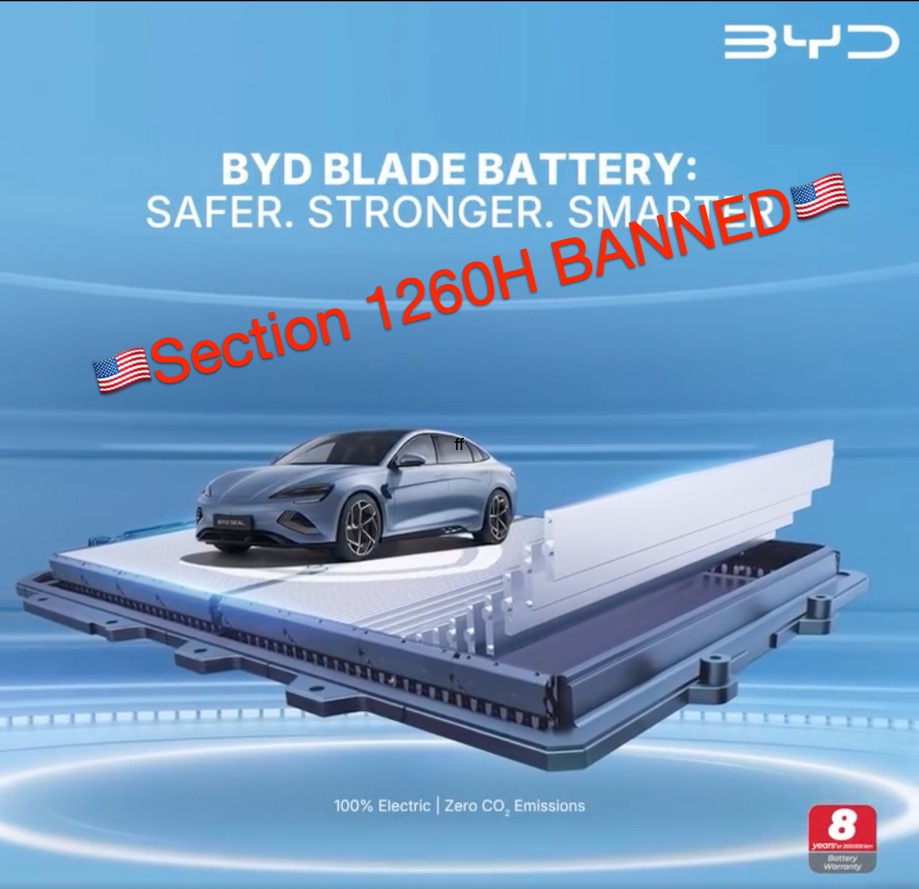
U.S. blacklists BYD, Nio, and CALB as military-linked firms, reshaping EV supply chains and accelerating a split into separate Western and Chinese ecosystems.
Drivetech Partners
Washington's decision to place Chinese electric vehicle manufacturers BYD and Nio, along with battery producer CALB, on the Pentagon's Section 1260H "Chinese military companies" list marks a turning point where commercial EV leadership collides with national security policy. This designation doesn't ban trade outright, but it fundamentally changes the risk calculus for U.S. investors, lenders, and automakers, potentially splitting the global EV and battery supply chain into separate Western and Chinese ecosystems as industrial policy and the race for clean-tech dominance increasingly overlap.
Key Takeaways
- The Pentagon's Section 1260H blacklist now includes 188 Chinese companies, expanding beyond defense firms to target private-sector champions in EVs, batteries, AI, robotics, and solar.
- While the designation doesn't immediately ban trade, it creates procurement restrictions beginning June 30, 2026, and raises compliance risk that affects valuation, partnerships, and investment decisions.
- Global automakers must now reassess sourcing strategies for indirect exposure through components, subsidiaries, and joint ventures, likely accelerating dual sourcing and China-plus-one approaches.
- The blacklist may unintentionally push Chinese EV and battery firms toward self-contained ecosystems with domestic suppliers, capital, and technical standards less dependent on Western markets.
- EVs have transformed from consumer products into strategic assets tied to data, semiconductors, and manufacturing capacity, deepening the geopolitical split between Western and Chinese clean-tech blocs.
Washington Targets Commercial EV and Battery Giants, Not Just Defense Firms
The Pentagon's latest update to its Section 1260H list represents a significant expansion of what Washington considers a national security threat. Created under the 2021 National Defense Authorization Act, this statutory blacklist originally focused on traditional defense contractors and state-owned enterprises with clear military ties. Now it reaches into the heart of China's commercial technology sector, designating firms the Pentagon says support China's military-civil fusion strategy.
The 2026 update added major private-sector names including BYD, Nio, and CALB alongside tech giants Alibaba and Baidu, robotics company Unitree, LiDAR makers Hesai and RoboSense, display manufacturer BOE Technology Group, solar producers JA Solar and Trina Solar, router maker TP-Link, and biotech firm WuXi AppTec. According to South China Morning Post, this expansion signals that Washington views commercial leadership in strategic sectors as inseparable from national security considerations.
The list has grown dramatically from 46 entities plus subsidiaries after a January 2024 update to a total of 188 Chinese companies today, as detailed in Pentagon documentation. This isn't just a defense story anymore. It's a supply-chain and geopolitics narrative showing that EVs, batteries, semiconductors, robotics, AI, and manufacturing capacity are now treated as strategic assets in a broader technological competition between powers.
What the Blacklist Does—and Doesn't Do—to Trade and Investment
Here's what many observers miss: the Section 1260H designation does not automatically ban trade with listed companies. You can still buy BYD vehicles or CALB battery cells tomorrow. What changes is the cost, legality, and risk calculation for any U.S. firm considering deeper partnerships with these entities.
The real teeth come from staged DoD contracting restrictions under the FY2024 NDAA. According to Dechert analysis, a direct procurement ban begins June 30, 2026, prohibiting the Department of Defense from entering, renewing, or extending contracts with listed entities. An indirect procurement ban follows on June 30, 2027, covering goods or services produced or developed by blacklisted firms even when purchased through intermediaries.
This creates what I'd call a reputational and compliance shock that ripples far beyond government contracts. U.S. investors must now conduct enhanced due diligence before putting capital into these companies. Lenders face heightened counterparty screening requirements. Corporate partners need board-level decisions about whether continued relationships create unacceptable risk exposure. Even without an instant prohibition, the designation affects valuation, procurement eligibility, and partnership negotiations in ways that can be just as effective as a direct ban.
The Section 1260H list also differs from the Commerce Department's Entity List, which imposes export controls requiring licenses for technology transfers. As Asia Financial reports, the Commerce list contains more than 1,000 organizations and people, with 80+ Chinese entities added in recent export-control actions. The two tools work in tandem but target different choke points: Section 1260H restricts access to American capital and government contracts, while Entity List restrictions limit access to advanced technology and components.
One crucial detail: the Pentagon can remove firms from the list, making this a dynamic policy instrument rather than a permanent sentence. That flexibility shows Washington intends the list as an ongoing pressure mechanism, not merely a symbolic gesture.
Why BYD, Nio, and CALB Sit at the Center of EV Supply Chains
BYD isn't just another EV maker—it's arguably the world's most important EV player and a symbol of China's manufacturing scale and vertical integration. The company produces vehicles, batteries, semiconductors, and even the manufacturing equipment to make all of the above. Blacklisting BYD sends a signal that no Chinese firm, regardless of commercial success or private ownership, sits beyond the reach of U.S. security designations.
Nio represents a different strategic message. This premium EV brand competes in the luxury segment with innovative battery-swap technology and a customer experience model borrowed from high-end Western automakers. Its inclusion demonstrates that the blacklist extends beyond mass-market manufacturers or state-owned enterprises to encompass privately-held innovators across the entire EV market spectrum.
CALB's designation carries perhaps the most direct supply-chain implications. Battery makers sit at the center of the EV supply chain, where industrial policy and national-security concerns overlap most directly. Modern lithium-ion battery production requires tightly coordinated inputs including cells, cathodes, packs, electronics, semiconductors, software, and specialized manufacturing equipment. A single battery pack contains technology from dozens of suppliers across multiple countries, making counterparty screening extraordinarily complex when even one company in that web carries a Pentagon designation.
This complexity explains why the CALB listing may ultimately prove more disruptive than the vehicle manufacturers. Automakers can, in theory, source complete battery packs from alternative suppliers in South Korea, Japan, or emerging production in North America and Europe. But untangling indirect exposure through components, chemical precursors, or embedded software from a blacklisted battery producer requires forensic-level supply-chain mapping that most procurement teams aren't equipped to handle.
How Multinational Automakers Will Reassess Sourcing Strategies
Global automakers now face an uncomfortable reality: they must reassess sourcing, contract structures, and compliance screening across every point where their supply chains touch listed entities. The risk isn't limited to writing a purchase order directly to BYD or CALB. It extends to indirect exposure through components supplied by their subsidiaries, joint ventures that share technology, or embedded software and electronics that originated from blacklisted firms even when integrated by third parties.
I expect to see divergent responses based on market exposure. U.S.-facing brands—whether domestic manufacturers or foreign automakers with significant American sales—will likely avoid direct ties to listed firms because government-contract eligibility and reputational risk outweigh any cost savings. Ford, GM, and Stellantis all supply vehicles to federal, state, and local government fleets. Maintaining that business requires clean sourcing that won't trigger indirect procurement restrictions when the 2027 deadline arrives.
Globally diversified brands face a different calculation. For manufacturers selling primarily in Europe, Asia, and Latin America, Chinese suppliers offer cost and scale advantages that remain difficult to replace quickly. These companies will likely maintain China sourcing while adding compliance firewalls—separate legal entities, regional supply-chain segregation, and alternative suppliers for U.S.-destined products. According to Morgan Lewis analysis, this creates selective decoupling pressure around companies most exposed to U.S. government procurement, financing, or technology ecosystems.
The practical result will be a shift toward dual sourcing strategies, where automakers qualify multiple suppliers for critical components and maintain active relationships with both Chinese and non-Chinese providers. Regional supplier diversification will accelerate, with more investment in South Korean battery makers, Japanese component manufacturers, and emerging capacity in North America and Europe. China-plus-one strategies—where companies maintain Chinese suppliers while building alternative sources elsewhere—will become the new normal for OEM sourcing.
This won't be blanket decoupling. Instead, expect a fragmented approach where sourcing decisions depend on specific risk exposure, end-market destinations, and the regulatory classification of each product line. The same automaker might source batteries from CALB for vehicles sold in Asia while using LG Energy Solution or Panasonic for North American production.
The Unintended Catalyst: Building More Self-Contained Chinese Clean-Tech Ecosystems
Washington's blacklist may achieve its immediate goal of reducing Chinese firms' access to U.S. capital and technology, but it could simultaneously accelerate an outcome American policymakers didn't intend: pushing China's EV and battery industries toward more self-contained ecosystems independent of Western markets and standards.
Listed firms now have stronger incentives to deepen ties with Chinese suppliers, banks, customers, and standards bodies rather than pursuing cross-border integration. When access to U.S. investors becomes restricted and partnerships with American firms carry compliance risk, the rational response is to build more complete domestic value chains. BYD, Nio, and CALB will increasingly source components from Chinese semiconductor makers, secure financing from Chinese banks, and adopt technical standards developed by Chinese industry consortia rather than international bodies where U.S. firms hold influence.
This dynamic turns the blacklist into both a restriction and a catalyst. Pressure from Washington reduces cross-border integration while reinforcing Chinese government efforts to localize technology development, financing, and industrial standards. China's "dual circulation" economic strategy—which emphasizes domestic consumption and self-reliance in strategic sectors—receives validation every time a U.S. policy action makes Chinese firms question their dependence on Western markets.
What does a China-centric ecosystem look like in practice? Picture a network of domestic champions connected through regional supply chains, funded by local capital markets, and operating under Chinese technical standards for charging infrastructure, battery specifications, vehicle-to-grid integration, and autonomous driving systems. This ecosystem already exists in embryonic form. The blacklist provides additional momentum for its maturation by making Western alternatives less accessible and less attractive.
The incentive structure now favors inward-focused innovation and regional partnerships over transatlantic integration. Chinese EV makers will expand more aggressively in Southeast Asia, the Middle East