Quantum computing threatens encryption today as attackers harvest data for future decryption, breaking RSA/ECC systems before adequate defenses are deployed.

Drivetech Partners
The quantum computing era poses an immediate threat to our digital security infrastructure with cyberattackers already harvesting encrypted data today for future decryption. Kaspersky and other cybersecurity leaders warn that quantum computing advances could break current encryption standards before adequate defenses are widely deployed, creating a security crisis for unprepared organizations.
Key Takeaways
- "Store now, decrypt later" attacks are already underway, with adversaries collecting encrypted data to decrypt when quantum computers become powerful enough
- Common encryption systems like RSA and ECC that secure internet communications and blockchain transactions are fundamentally vulnerable to quantum algorithms
- The NIST standardization of post-quantum cryptography algorithms offers new defense options, but organizational adoption remains dangerously low
- Global regulators including the EU and NSA have established transition timelines with critical deadlines between 2026-2035 for quantum-safe implementations
- Organizations must develop cryptographic agility to quickly adapt their systems as quantum computing threats materialize faster than anticipated
The Quantum Decryption Threat: Why Organizations Must Act Now
Quantum computing isn't a distant future concern – it represents a clear and present danger to current cybersecurity practices. While functional quantum computers with enough qubits to break encryption aren't commercially available yet, the groundwork for devastating attacks is being laid right now. Cybersecurity leaders including Kaspersky have raised alarms that quantum advances are outpacing defensive preparations, putting vast amounts of sensitive data at risk.
The threat is unique because it doesn't require quantum computers to exist today. Attackers are already collecting encrypted data, knowing they'll eventually have the tools to decrypt it. This reality changes the security calculation dramatically – data you secure today could be compromised years or decades from now when quantum decryption becomes practical.
Understanding "Store Now, Decrypt Later" Attacks
The core of this threat lies in what security experts call "Store Now, Decrypt Later" (SNDL) or "Harvest Now, Decrypt Later" (HNDL) attacks. The methodology is straightforward but devastating: cybercriminals intercept and collect encrypted data today that they can't yet break, stockpiling it until quantum computing advances make decryption possible.
The attack operates in three distinct phases:
- Data harvesting: Attackers capture encrypted information including financial transactions, intellectual property, government communications, and healthcare records during transit or from storage
- Long-term storage: With storage costs falling yearly, it's economically viable to retain petabytes of encrypted data indefinitely
- Future decryption: When quantum computers reach sufficient capability, attackers decrypt and exploit the historical data
What makes this attack particularly concerning is that decades-old communications could suddenly become vulnerable. Data you assumed was securely encrypted in 2024 might be fully exposed in 2030 or beyond, creating security implications that extend far into the future.

Why Traditional Encryption Is Vulnerable
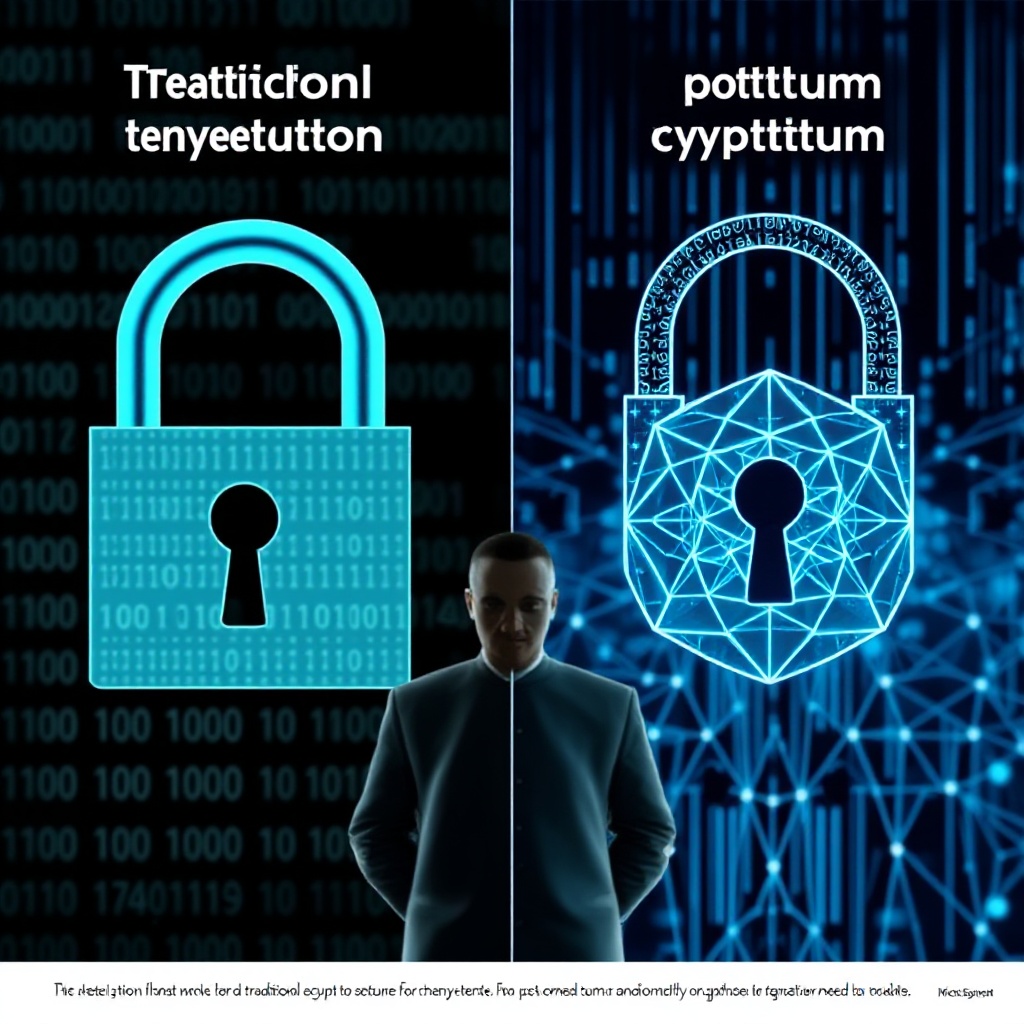
The vulnerability stems from the mathematical foundations of our most trusted encryption systems. Public-key cryptography like RSA and Elliptic Curve Cryptography (ECC) secures nearly everything from website connections and email to digital signatures and VPNs. These systems rely on computational hardness – the fact that certain mathematical problems take impractical amounts of time to solve with classical computers.
Quantum computers change this calculation entirely through two key algorithms:
- Shor's Algorithm: Can efficiently factor large numbers, breaking RSA encryption that would take classical computers thousands or millions of years to crack
- Grover's Algorithm: Effectively halves the security of symmetric encryption (making AES-256 equivalent to roughly 128-bit security in a quantum context)
The implications span across industries. Financial institutions securing transactions, healthcare organizations protecting patient data, government agencies transmitting classified information, and blockchain applications verifying ownership all face the same fundamental risk. The encryption methods they rely on will become obsolete against quantum attacks.
The Blockchain and Long-Term Data Security Crisis
Blockchain technology faces a particularly existential threat from quantum computing. Most blockchain implementations rely heavily on ECC for transaction signatures and identity verification. The immutability promised by blockchain fundamentally depends on these cryptographic primitives remaining unbreakable.
When quantum computers can execute Shor's algorithm at scale, they could:
- Forge transaction signatures, undermining the integrity of cryptocurrency transfers
- Extract private keys from public keys, enabling theft of digital assets
- Compromise smart contracts that rely on cryptographic security assumptions
- Rewrite transaction history, breaking the immutability guarantee
Beyond blockchain, the risk extends to any long-lived sensitive data. Medical records that must remain confidential for decades, legal documents with long-term privacy requirements, and government communications could all become vulnerable retrospectively. Data breaches today might lead to consequences decades in the future as quantum decryption tools become available.
Post-Quantum Cryptography: The New Defense Standard
The good news is that cryptographers haven't been idle. The National Institute of Standards and Technology (NIST) has been leading a multi-year standardization effort for post-quantum cryptography (PQC) algorithms specifically designed to resist quantum attacks.
In 2024, NIST finalized standards for three critical PQC algorithms:
- ML-KEM (Crystals-Kyber): For key encapsulation (replacing RSA/Diffie-Hellman key exchange)
- ML-DSA (Crystals-Dilithium): For digital signatures (replacing ECDSA/RSA signatures)
- SLH-DSA (HSS/LMS): For stateless hash-based signatures (replacing RSA/DSA signatures)
A fourth algorithm, FND-DSA (Falcon), is pending final standardization. These algorithms rely on different mathematical problems that resist both classical and quantum attacks while maintaining practical performance for real-world applications.
Global Transition Timelines and Regulatory Pressure
Recognizing the urgency, governments and regulatory bodies worldwide have established concrete transition timelines for moving to post-quantum cryptography:
The European Union has published a detailed roadmap requiring:
- By end of 2026: All EU member states must have national post-quantum migration plans
- By end of 2030: PQC deployment for high-risk use cases and quantum-safe software updates by default
- By end of 2035: Complete PQC implementation for medium-risk cases
In the United States, the National Security Agency (NSA) and NIST have outlined their own timeline through the Commercial National Security Algorithm 2.0 (CNSA 2.0) program:
- 2025-2030: Software and firmware signing must use PQC
- 2025-2033: PQC implementation in browsers, servers, and cloud services
- 2033: Full transition deadline for US National Security Systems
These regulatory deadlines create both compliance pressure and a clear roadmap for organizations to follow in their quantum-safe transition efforts.
Why Organizations Remain Dangerously Unprepared
Despite the clear warnings and established timelines, most organizations remain woefully unprepared for the quantum threat. Few have conducted proper quantum risk assessments or begun PQC implementation planning. This organizational inertia stems from several key factors:
- Incomplete cryptographic inventory: Most organizations don't know where and how they're using vulnerable cryptography throughout their systems and supply chains
- Unclear ownership: The quantum threat crosses traditional organizational boundaries between security, infrastructure, and application teams
- Technical complexity: Retrofitting existing applications with PQC can be challenging, especially for legacy systems
- Economic barriers: Comprehensive PQC implementation requires significant investment without immediate ROI
- Supply chain dependencies: Many organizations rely on vendors who haven't yet prioritized PQC implementation
This preparation gap creates a dangerous situation where quantum computing advances could outpace defensive measures, leaving critical data vulnerable to SNDL attacks.
Strategic Recommendations for Quantum-Safe Transition
Organizations need to take concrete steps now to prepare for the quantum computing era. Here's a practical roadmap for your quantum-safe transition:
- Assess your quantum risk: Inventory all uses of RSA, ECC, and other vulnerable algorithms throughout your organization and supply chain
- Build cryptographic agility: Design systems to allow for swift algorithm replacement without major architectural changes
- Begin PQC pilots: Test NIST-standardized algorithms (ML-KEM, ML-DSA, SLH-DSA) in non-production environments to understand implementation challenges
- Develop a phased transition plan: Prioritize high-value and long-lived data systems for early migration
- Educate stakeholders: Ensure leadership understands the risk and technical teams have the skills needed for PQC implementation
The transition to quantum-safe cryptography isn't just a technical challenge – it's a strategic imperative for any organization that values data security. By starting now, you can methodically address the risks while avoiding the crisis of rushed implementations when quantum computing threats fully materialize.
Organizations that proactively adopt PQC will gain competitive advantages in security posture, regulatory compliance, and customer trust. Those that wait may find themselves scrambling to implement complex cryptographic changes under pressure, potentially after sensitive data has already been harvested for future decryption.