Mazda CX-6e debuts with radical 26-inch screen, 78 kWh battery delivering 301 miles range, AR head-up display, and calm minimalism design for summer 2026.

Drivetech Partners
The Mazda CX-6e, unveiled at the Brussels Motor Show on January 9, 2026, challenges the electric SUV segment with a radical interior approach centered on a massive 26-inch touchscreen that replaces traditional dashboard layouts entirely. This mid-size crossover pairs its 78 kWh LFP battery delivering up to 301 miles WLTP range with a cabin philosophy Mazda calls "calm minimalism," offering a distraction-free driving experience through augmented reality displays and gesture controls while maintaining the brand's signature Jinba-ittai driving dynamics tuned specifically for European roads.
Key Takeaways
- The CX-6e features a revolutionary 26-inch 5K-resolution screen with 32:9 aspect ratio that completely eliminates the traditional instrument cluster
- A 78 kWh LFP battery delivers 290-301 miles WLTP range with 258 hp rear-wheel-drive performance and 195 kW DC fast charging
- The augmented reality head-up display projects speed and navigation data onto the windshield for distraction-free viewing
- Interior space includes 15 cm knee room for rear passengers, 363-1434 L cargo capacity, and a 126 L frunk under a panoramic glass roof
- European launch scheduled for summer 2026 with estimated £45,000 starting price competing directly with Tesla Model Y
Introduction to Mazda CX-6e
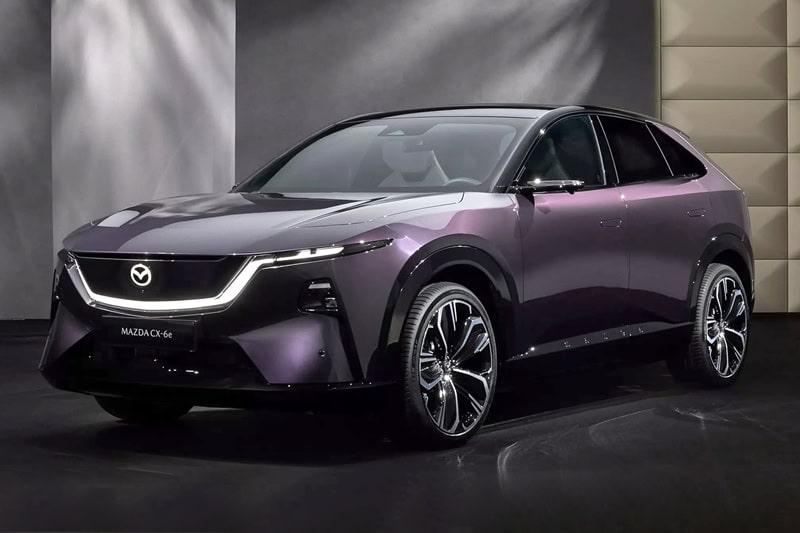
Mazda's entry into the competitive mid-size electric SUV market arrives with the CX-6e, a vehicle that represents a significant departure from conventional EV design philosophy. Developed through the Changan Mazda joint venture and based on the Deepal S07 platform, this crossover launches in Europe summer 2026 and Australia later the same year. Known as the EZ-60 in China where it's been on sale since September 2025, the CX-6e embodies Mazda's "FUTURE + SOUL x MODERN" design philosophy while maintaining the brand's core Jinba-ittai principle—the Japanese concept of human-machine unity that defines intuitive handling.
The timing couldn't be more strategic. With Mazda 6e sales already exceeding 7,000 units, the brand has demonstrated its capability to compete in the EV space. The CX-6e positions itself against established rivals like the Tesla Model Y, Skoda Enyaq, and Kia EV5, but distinguishes itself through larger dimensions and a unique interior approach. Where competitors have iterated on existing dashboard designs, Mazda has reimagined the entire driver-passenger interface from scratch. This isn't just another electric SUV—it's a statement about what cabin technology can become when manufacturers prioritize driver focus over feature lists.
Revolutionary Interior and Technology
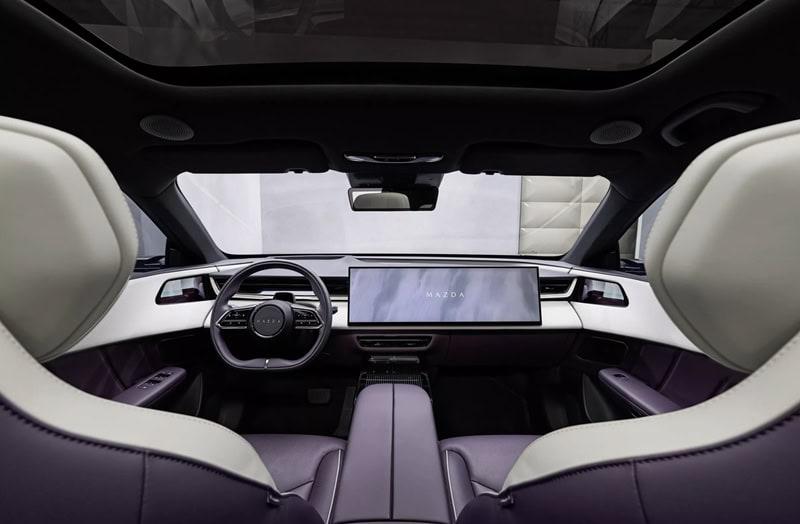
The centerpiece of the CX-6e's cabin is impossible to miss: a 26-inch 5K-resolution touchscreen with a 32:9 aspect ratio that spans the entire dashboard from driver to passenger. This ultrawide display eliminates the traditional instrument cluster entirely, creating a seamless digital interface that dwarfs the Tesla Model Y's 15-inch vertical screen. The implementation reflects Mazda's "calm minimalism" design approach, inspired by the Japanese aesthetic concept of "Ma"—the beauty found in empty space and simplicity.
Rather than cluttering the driver's view, Mazda routes critical information through a 100-inch 3D augmented reality head-up display (AR-HUD) that projects speed, navigation overlays, and driving data directly onto the windshield. This setup keeps your eyes on the road while maintaining full awareness of vehicle status. I've found this approach more intuitive than constantly glancing down at traditional gauges or even modern digital clusters.
The technology stack extends well beyond the primary display. Key features include:
- Gesture controls for hands-free operation of climate, media, and navigation functions
- Multilingual voice recognition that responds to natural language commands
- Headrest-integrated Bluetooth speakers delivering private audio without disturbing other passengers
- Rear ventilated seats controllable via a dedicated rear screen
- Optional 23-speaker 7.1.4 Dolby Atmos sound system for immersive audio
- 256-colour ambient lighting that adapts to driving modes and time of day
- Digital side mirrors displayed on door-mounted screens
Consider a typical user scenario: your passenger wants to watch a movie during a long highway stretch. They can control their entertainment on the passenger side of the 26-inch screen while the AR-HUD keeps you focused on navigation and speed. The headrest speakers mean they don't need headphones, yet you won't hear their content. This level of personalization within a shared space represents a genuine advancement over the one-size-fits-all approach of rivals.
Compared to the Tesla Model Y's single central screen that requires both driver and passenger to share viewing angles, the CX-6e's implementation feels more thoughtful. The wider format naturally divides into zones without requiring complex menu structures or split-screen compromises.
Powertrain and Performance
Underneath the revolutionary cabin sits a 78 kWh LFP (Lithium Iron Phosphate) battery powering a 258 hp (190 kW) rear-wheel-drive electric motor that produces 290 Nm of torque. The sprint from 0-100 km/h takes 7.9 seconds, with a top speed electronically limited to 185 km/h (115 mph). These aren't supercar numbers, but they're perfectly adequate for a mid-size family SUV focused on efficiency and everyday usability.
Range figures hit 468-484 km WLTP (290-301 miles), placing the CX-6e slightly behind the Tesla Model Y's 314-390 mile range depending on configuration. Energy consumption registers between 18.9-19.4 kWh/100 km, competitive for this vehicle class. The DC fast charging capability reaches 195 kW maximum, enabling 10-80% charges in approximately 24 minutes—critical for long-distance travel anxiety.
The LFP battery chemistry brings specific advantages beyond just capacity. These cells offer enhanced durability and safety characteristics, meeting the stringent 2026 China crash standards. LFP batteries typically tolerate more charge cycles than conventional lithium-ion alternatives, potentially extending the vehicle's useful life. Prototype testing of the similar Mazda 6e achieved 7.35-second 0-100 km/h times, suggesting real-world performance may slightly exceed official figures.
Drive modes include Normal, Sport, and Individual settings that adjust throttle response, steering weight, and regenerative braking intensity. The suspension setup combines front McPherson struts with rear multi-link geometry, tuned in Germany specifically for European road conditions. This is where Mazda's Jinba-ittai philosophy translates into tangible handling benefits—the CX-6e feels more connected and responsive than the Model Y's comfort-biased setup, even if absolute performance metrics don't dramatically differ.
Practical considerations include a braked towing capacity of 1500 kg, competitive with rivals in this segment. Whether you're hauling a small camper or boat trailer, the CX-6e won't leave you stranded.
Dimensions, Space, and Practicality
The CX-6e measures 4850 mm in length, 1935 mm in width, and 1620 mm in height, riding on a 2902 mm wheelbase. These dimensions make it notably larger than the CX-5, Tesla Model Y, and Skoda Enyaq, translating directly into interior volume. Rear passengers get a generous 15 cm of knee room, sufficient for adults over six feet tall to sit comfortably on longer journeys. The standard panoramic glass roof enhances the airy cabin feel without compromising headroom.
Boot capacity starts at 468 L in standard configuration, expanding to a maximum of 1434 L with rear seats folded. The range between 363-1434 L suggests multiple cargo floor configurations. An additional 126 L frunk up front provides dedicated storage for charging cables and smaller items you'd prefer to keep separate from main cargo. This gives the CX-6e approximately 100 L more total boot space than the Skoda Enyaq Coupe.
Ground clearance sits at 158 mm—adequate for light off-road duties and rough road surfaces, though this isn't positioned as a serious off-roader. The turning circle measures 12.4 m, manageable for a vehicle of this size in urban environments. Kerb weight registers at 2130 kg, typical for an electric SUV with a 78 kWh battery pack.
Practical touches include:
- Multiple charging port options for international markets
- Powered tailgate as standard equipment
- Configurable cargo floor for optimizing vertical space
- Dedicated frunk organization for cables and emergency equipment
- Rear seat ventilation controllable via touch interface
The 1500 kg braked towing capacity matches or exceeds most competitors, making the CX-6e viable for weekend adventures with lightweight trailers or bike racks.
Design and Aerodynamics
Mazda's signature Kodo design language translates into the electric era with a body-color grille and contrasting black roof. The exterior isn't revolutionary, but it's refined—evolution rather than revolution suits buyers who want an EV that doesn't scream for attention. The proportions balance SUV practicality with coupe-like roofline styling that improves aerodynamics without sacrificing rear headroom.
Aerodynamic optimization receives serious attention. Mazda incorporated 9 air vents including curtains around the wheels and slotted D-pillars that manage airflow. These refinements reduce drag by 60.8 counts compared to a baseline design, adding approximately 41 km of range through aero efficiency alone. The system also generates 705 N of downforce at highway speeds, improving stability without dedicated spoilers or wings that would increase drag.
Wheel options include 19-inch or 21-inch designs, wearing 235/55 R19 or 255/40 R21 tires respectively. The smaller wheels will optimize range while the larger set enhances visual presence and potentially handling response. The panoramic sunroof comes standard across all trim levels, a feature many competitors charge extra for.
Compared to the hypothetical CX-5 EV that never materialized, the CX-6e adopts a more progressive stance with better aerodynamic integration. The design balances Mazda's traditional aesthetic values with the practical requirements of electric propulsion.
Safety and ADAS Features
Safety equipment starts with 9 airbags